Originally published in the California Academy of Physicians Associates (CAPA) Quarterly Summer 2026 Magazine
By Bessie O’Connor, RDN
The 2025–2030 Dietary Guidelines for Americans, released in January 2026, serves as the foundation for federal nutrition programs, public health initiatives and community nutrition education. Despite the important role the Dietary Guidelines plays in shaping federal nutrition programs and public health policy, it is not the primary driver of food choices for most people. National Health and Nutrition Examination Survey data suggest that U.S. dietary patterns, on average, do not closely align with the Dietary Guidelines.1 This gap highlights that food decisions are shaped by a range of influences including taste, cost and convenience. There is an opportunity to more closely align nutrition education and clinical guidance with these real-world constraints, helping patients move toward healthier eating patterns.
The newest Dietary Guidelines continue to emphasize healthy eating patterns across the lifespan, with increased attention to protein and diet quality. Recommendations for daily protein intake increased from 0.8 grams per kilogram of body weight to 1.2–1.6 grams per kilogram of body weight. For example, a 160-pound person’s needs increased from 58 grams to 87–116 grams per day, adjusting based on individual needs. The guidelines maintained the recommendation to limit calories from saturated fat to less than 10% of total daily intake but encourage Americans to choose whole-food sources of saturated fat. These sources include dairy foods, which are recognized across all fat levels as nutrient-dense sources of calcium, vitamin D, potassium and protein that positively impact health. The Dietary Guidelines place greater emphasis on limiting added sugars, especially among children, and recommends minimizing highly processed food intake, while continuing to encourage nutrient-dense foods such as fruits, vegetables and whole grains. MyPlate, the visual depiction of the Dietary Guidelines since 2011, was replaced by a new pyramid, which places less focus on specific food groups and emphasizes an “eat real food” philosophy.2
Changes to the Dietary Guidelines have already had implications for federal nutrition policy. For example, new guidance around dairy fat was a factor in the final rule of the Whole Milk for Healthy Kids Act,3 which expands options for milk fat levels in school meals and other federal nutrition programs. These changes align to research suggesting that whole-fat milk does not contribute to increased adiposity in children.4,5,6 Studies suggest that the reason may be due to the complex dairy matrix that influences health outcomes rather than looking at isolated nutrients. Tracking the public health implications of these changes to federal meal programs will continue to inform nutrition science and future recommendations.
While the Dietary Guidelines has an impact on federal nutrition policy and food environments, awareness and understanding do not necessarily translate into action. While many Americans are aware of nutrition recommendations, everyday food decisions are often driven more by factors such as taste, cost, convenience, social influences and information encountered on social media than by formal dietary guidance.7 Even so, many consumers express preferences that align with core Dietary Guidelines principles, like limiting added sugars and choosing more nutrient-dense foods. The challenge appears to be less about understanding what healthy eating looks like and more about overcoming practical barriers to implementing those behaviors.8
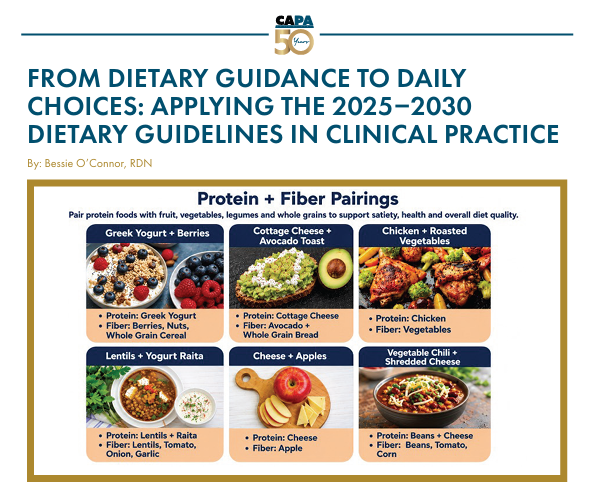
In this context, the Dietary Guidelines functions less as a prescriptive checklist and more as a framework for moving patients closer to nutritious eating patterns based on their lived experiences. For preventive conversations in clinical settings, this may mean prioritizing brief recommendations that emphasize convenient and budget-friendly ways to support healthy eating patterns. One approach is pairing protein-rich foods (milk, yogurt, cheese, nuts, nut butters, legumes, tuna, eggs, tofu) with fiber-rich foods (fruits, vegetables, whole grains) at meals and snacks.
These foods can be fresh, frozen or canned. Milk and dairy foods are an affordable source of high-quality protein and essential nutrients and pair well with fruits, vegetables and whole grains to maximize nutrition. This strategy translates dietary recommendations into simple advice that supports satiety, nutrient adequacy and overall diet quality while remaining realistic for everyday life.
Health professionals are uniquely positioned to support families in making healthy lifestyle changes through evidence-based nutrition education. By sharing practical, science-based resources and consistent nutrition messages, they can help individuals and families make informed choices that promote lifelong health. Explore free nutrition education resources for patients and their families.
References
1. National Center for Health Statistics. National Health and Nutrition Examination Survey (NHANES) Data. Centers for Disease Control and Prevention website. Published April, 2020. Accessed May 26, 2026. Available at: https://www.cdc.gov/ nchs/nhanes
2. US Department of Agriculture, US Department of Health and Human Services. Dietary Guidelines for Americans, 20252030. 10th ed. Published January 2026. Accessed May 26, 2026. Available at: https://www.dietaryguidelines.gov
3. Whole Milk for Healthy Kids Act of 2025, Pub L No. 119-69, 2026. Accessed May 26, 2026. https://www.govinfo.gov/ link/plaw/119/public/69
4. Soltani S, Vafa M. The dairy fat paradox: whole dairy products may be healthier than we thought. Med J Islam Repub Iran. 2017;31:110. doi:10.14196/mjiri.31.110
5. Vanderhout SM, Aglipay M, Torabi N, et al. Whole milk compared with reduced-fat milk and childhood overweight: a systematic review and meta-analysis. Am J Clin Nutr. 2020;111(2):266-279. doi:10.1093/ajcn/nqz276
6. Zeitoun T, Chen ZH, Burgner D, et al. Milk fat intake, adiposity, and obesity in Canadian children: findings from the prospective Canadian CHILD Cohort Study. Am J Clin Nutr. 2026;123(5):101186. doi:10.1016/j.ajcnut.2025.101186
7. International Food Information Council. 2023 IFIC Food & Health Survey. Published May 23, 2023. Accessed June 2, 2026. https://ific.org/research/2023-food-and-healthsurvey
8. International Food Information Council. IFIC Spotlight Survey: Americans’ perceptions of the Dietary Guidelines for Americans. Published May 6, 2026. Accessed June 2, 2026. https://ific.org/research/americans-perceptions-of-dga
Meet the author, Dairy Council of CA staff member, Bessie O'Connor. Questions or opportunities for collaboration? Please contact Bessie O’Connor, Registered Dietitian Nutritionist at boconnor@dairycouncilofca.org.